
The Nepal Flood Travel Update 2026 provides travellers with verified information about the severe flooding that affected the Bhote Koshi–Trishuli river corridor on 26 August 2026.
The disaster caused significant loss of life and damaged communities, roads, bridges and other infrastructure, particularly in parts of Rasuwa, Nuwakot and Dhading. Search, rescue and recovery operations are continuing, and conditions may change quickly.
Last updated: 31 August 2026, 6:00 PM Nepal time
Important travel notice: This article provides general information based on reports available at the time shown above. It is not a live route-clearance notice. Confirm your exact road, flight and trekking arrangements with your registered operator and the relevant authorities immediately before travelling.
What Happened in Nepal on 26 August 2026?
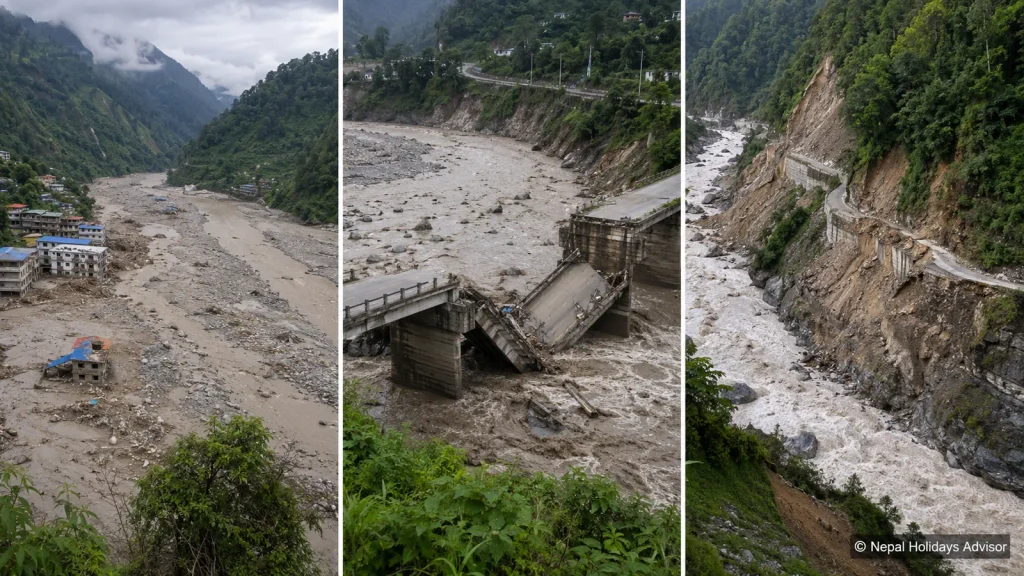
A sudden and destructive flash flood moved through the Bhote Koshi and Trishuli river systems in north-central Nepal on 26 August.
The flood affected settlements and infrastructure along the river corridor, with serious impacts reported in Rasuwa, Nuwakot and Dhading. Roads, bridges, homes, hydropower facilities, water systems and communication networks were among the infrastructure affected.
Emergency operations remain active. Because official figures continue to change as previously inaccessible locations are reached, travellers should avoid sharing unverified casualty numbers or reports taken from social media.
The latest humanitarian information can be followed through the Nepal flood emergency page on ReliefWeb.
Our thoughts are with the people who have lost family members, homes and livelihoods, as well as the rescue teams and local communities supporting the response.
Which Areas Are Most Directly Affected?
The most serious direct impacts reported in the information reviewed for this update are concentrated along the Bhote Koshi–Trishuli corridor.
Rasuwa and the Rasuwagadhi Corridor
Rasuwa is among the most severely affected districts. Travellers should exercise particular caution with journeys towards:
- Betrawati
- Mailung
- Syabrubesi
- Dhunche
- Rasuwagadhi
- Langtang trekking access points
- Communities close to the Trishuli and Bhote Koshi rivers
Even when part of a road has reopened, conditions may remain unsuitable for ordinary tourist movement. Recovery vehicles, emergency teams and local residents should be given priority.
Nuwakot
Settlements and infrastructure along the Trishuli River in Nuwakot have experienced significant disruption. Road access may change as debris is cleared and weakened sections are assessed.
Do not rely only on digital maps, which may continue showing a route even when a bridge or road section is closed.
Dhading and Downstream Areas
Flood impacts and warnings have also affected areas farther downstream. Heavy rain can create additional local landslides, falling rocks and sudden changes in river levels even after the original flood has passed.
Travellers using routes through Dhading should confirm current conditions shortly before departure.
Are Nepal’s Roads Open After the Flood?
Road conditions are mixed and changing.
The Nepal Department of Roads reports that parts of the Galchi–Trishuli–Betrawati–Mailung–Syabrubesi–Rasuwagadhi corridor have partially reopened, while other sections have remained closed or severely damaged.
“Partially open” does not necessarily mean a route is suitable for tourist vehicles, night travel or regular schedules.
Check the Nepal Department of Roads road-closure report before departure. Your driver or trekking operator should also obtain a same-day local update.
When travelling by road:
- Avoid departures based only on an old road report
- Do not cross floodwater or unstable road sections
- Never move road barriers installed by authorities
- Avoid unnecessary travel after dark
- Expect delays at damaged bridges and landslide zones
- Carry water, essential medicine and a charged phone
- Allow emergency and recovery vehicles to pass
- Follow instructions from police, road officials and local authorities
A reopened road can close again if rain triggers another landslide or if engineers identify structural damage.
Is It Safe to Travel to Nepal Now?
There is no simple countrywide yes-or-no answer.
The reports reviewed for this update identify the Bhote Koshi–Trishuli corridor as the principal disaster area. They do not describe every part of Nepal as closed. However, Nepal remains in the monsoon season, and heavy rainfall can cause separate local floods, landslides, flight delays and road disruption in other districts.
Travellers should make decisions based on their exact itinerary rather than general social-media posts about the whole country.
Before continuing with a trip, confirm:
- Whether your destination is within or near an affected district
- The present condition of every required access road
- Whether your accommodation is operating normally
- Whether public transport is running
- Whether your trekking trail has been assessed
- Whether domestic flights are operating
- Whether alternative routes are practical
- Whether your insurer covers itinerary changes
- Whether local authorities have issued restrictions
Nepal Holidays Advisor will not describe a route as safe merely because it is technically open. Road stability, weather, vehicle suitability, daylight and access to emergency assistance must also be considered.
What About Langtang Valley Travel?
Langtang Valley is reached through Rasuwa, one of the districts most directly affected by the disaster. The access corridor towards Dhunche and Syabrubesi has experienced serious disruption.
Travellers should not begin a Langtang journey based on an earlier itinerary or an online map. Obtain current confirmation covering:
- The Kathmandu–Syabrubesi road
- Bridge and river-crossing conditions
- Local transport availability
- Accommodation in the access settlements
- Trail conditions beyond Syabrubesi
- Emergency communication and evacuation arrangements
- Weather expected during the trekking period
An operator may recommend postponing the trek, changing the departure date or selecting a different region. Such decisions should respect official restrictions and the needs of affected communities.
What About Other Trekking Regions?
Everest, Annapurna, Manaslu, Mustang and other trekking regions are not all located within the directly affected Trishuli corridor. However, that does not guarantee uninterrupted travel.
Each trek must be assessed individually because:
- Its road approach may pass through another monsoon-affected location
- Domestic flights may be delayed by visibility or weather
- Landslides can occur independently in different districts
- Rivers and suspension bridges may need inspection
- Accommodation or supply movements may be disrupted
- Rescue capacity may be focused on the emergency response
Ask for a route-specific assessment rather than accepting a general statement that all trekking is open or closed.
Travellers planning a Himalayan journey should also review our Best Time to Visit Nepal and Travel Insurance for Nepal guides.
Advice for Travellers Already in Nepal
If you are currently in Nepal:
- Follow instructions from local authorities, your accommodation and your registered travel operator.
- Avoid riverbanks, damaged bridges, landslide areas and crowds around rescue operations.
- Do not travel into an affected area to take photographs or videos.
- Keep your passport, insurance certificate and medicines accessible.
- Charge your telephone and portable power bank whenever electricity is available.
- Inform a trusted person of your location and intended movement.
- Keep additional time between road journeys and international flights.
- Retain receipts and written transport notices for possible insurance claims.
- Contact your airline before travelling to an airport.
- Contact your insurer promptly if your itinerary must change.
For a practical equipment checklist, see our Nepal Trekking Packing List.
Advice for Travellers Planning an Upcoming Trip
Do not cancel or continue your entire Nepal trip based only on a headline. Request detailed answers about your actual route.
Ask your travel company:
- Which districts will we enter?
- Are any roads, bridges or trails damaged?
- When was the route last checked?
- Has the local authority permitted tourist movement?
- Is the scheduled vehicle suitable for present road conditions?
- What alternative route or destination is available?
- Can the dates be changed without unnecessary loss?
- How many flexible days should be included?
- What is the emergency communication plan?
- Does the itinerary remain covered by my insurance?
If an operator cannot provide current, route-specific information, delay the decision until reliable details are available.
Monitor Weather and Flood Warnings
Nepal’s Department of Hydrology and Meteorology publishes weather forecasts, rainfall information and flood warnings.
Use the official DHM website and check it again immediately before road travel or trekking.
For weather and flood information within Nepal, dial:
- 1155
- Press 1 for weather forecasting
- Press 2 for flood early warning
Weather conditions can be different between Kathmandu, the Terai, hill districts and high mountain regions. A general national forecast should not replace information for your destination.
Emergency Numbers for Travellers in Nepal
Save these numbers before travelling:
| Service | Number |
|---|---|
| Nepal Police | 100 |
| Traffic Police | 103 |
| Tourist Police | 1144 |
| Weather and flood information | 1155 |
The Nepal Tourist Police operates the toll-free 1144 assistance line and maintains units in several tourism destinations.
In an emergency, give your name, telephone number, precise location, nearby landmark and the nature of the problem. Follow official instructions and avoid entering an unsafe area to assist unless requested by trained responders.
Travel Insurance and Itinerary Changes
Contact your insurer before changing or cancelling arrangements whenever circumstances allow.
Ask whether your policy covers:
- Trip cancellation or interruption
- Additional accommodation
- Transport delays
- Missed connections
- Emergency medical treatment
- Helicopter evacuation
- Alternative transport
- Lost or delayed baggage
Insurance normally depends on the policy wording, the reason for the disruption and supporting documents. Keep official notices, airline confirmations, medical reports and receipts.
Travel Responsibly During the Recovery
The affected communities are dealing with grief, displacement and damage to essential infrastructure.
Travellers should:
- Respect closures and community instructions
- Avoid disaster sightseeing
- Do not photograph injured or grieving people
- Keep rescue routes clear
- Avoid spreading unverified reports
- Use registered local businesses in operating areas
- Donate only through credible relief organisations
- Avoid placing extra pressure on limited food, fuel or accommodation
- Accept itinerary changes when a community is not ready to receive visitors
Responsible tourism means recognising when visiting can support a community and when staying away is more appropriate.
Frequently Asked Questions
Is all of Nepal closed to tourists?
The reports reviewed for this update do not describe a nationwide tourism closure. Conditions differ greatly by district and route. Confirm every part of your itinerary before travelling.
Should I cancel my Nepal trip?
A blanket decision is not appropriate for every traveller. Trips entering the affected corridor may need postponement or major changes, while an itinerary elsewhere may remain possible after a route-specific assessment.
Can I travel to Langtang Valley?
Rasuwa and the access corridor towards Syabrubesi have been seriously affected. Do not begin the journey without current confirmation from authorities and a registered operator.
Are trekking trails safe after heavy rain?
Trail conditions can change after every period of heavy rain. Landslides, damaged bridges and unstable river crossings may not be visible from the starting point. Use local professional guidance and obey closures.
Where can I check road conditions?
Use the Nepal Department of Roads road-closure system and obtain same-day information from your driver or operator.
Where can I check flood warnings?
Use Nepal’s Department of Hydrology and Meteorology website or dial 1155 within Nepal.
Planning or Reviewing a Nepal Itinerary
If you already have a Nepal journey planned, Nepal Holidays Advisor can help review the route, identify the districts involved and discuss responsible alternatives where appropriate.
We will base recommendations on current local information, official restrictions and realistic transport conditions. During this emergency, traveller safety and respect for affected communities must come before maintaining an original schedule.